
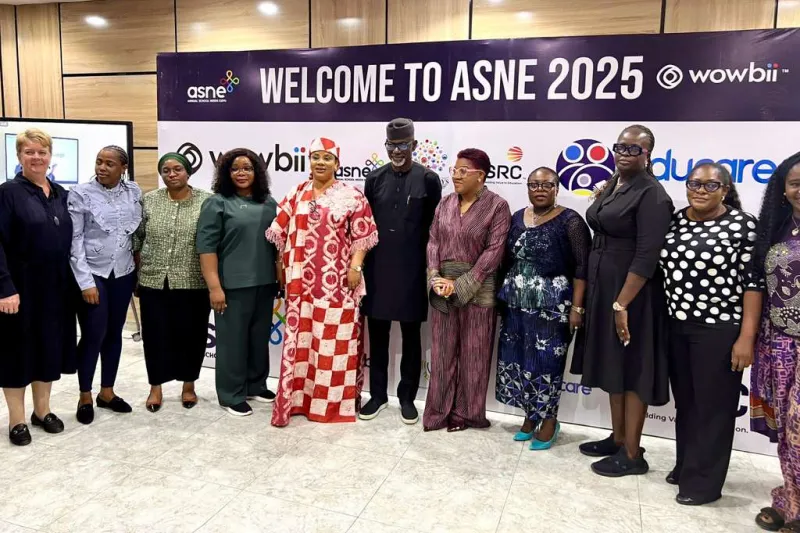

The 2025 Annual School Needs Expo (ASNE 2025) in Abuja gathered education leaders, policymakers, and technology innovators to call for an inclusive, data-driven reform agenda that bridges policy promises and classroom realities.
The convener, Ms Emem Opashi, said the event, held under the theme “Education X: Breaking Conventional Boundaries”, was created to help stakeholders collaborate across government, private, and civil sectors to strengthen Nigeria’s education system.
“Our focus is on collaboration across industries and with key decision makers to move education forward from our different areas of strength,” she said. “Until we have valid data to show outcomes, we can only commend intent. But what is encouraging is that these conversations are now happening publicly and intentionally.”
Opashi praised the government’s growing engagement in policy discussions but urged more evidence-based planning and consistency across administrations. She said the Expo’s broader aim was to ensure that public-school children receive education comparable to their private-school peers.

Former Cross River State Governor Liyel Imoke, who delivered the keynote address, traced Nigeria’s education journey from the missionary era to the present day. He commended milestones such as the Universal Primary Education of 1976 and the Universal Basic Education of 1999 but said exam-driven learning had stifled creativity.
“The colonial model gave us literacy and numeracy but also imposed memorisation over imagination,” Imoke said. “Globally, education has entered a revolution driven by technology, inclusion, and lifelong learning. Nigeria must not be left behind.”
He cited the National Digital Learning Policy of 2023 and the revised national curriculum as signals of a positive shift but emphasised that innovation must go beyond gadgets. “The real future is not artificial intelligence but augmented human intelligence,” he said. “Innovationmust empower teachers and students alike. The question for Africa is simple: will we be consumers of innovation or creators of it?”
Imoke said teacher training and strong partnerships were vital to scaling innovation, noting the work of his Bridge Leadership Foundation in Cross River State, which mentors young learners and trains teachers in collaboration with schools and private partners.
Representatives of Educare CEO Alex Onyia said schools must prepare for a full transition to computer-based testing as all major examination bodies plan to adopt CBT by 2026.
“Schools must roll out computer labs and familiarise learners with digital navigation and typing to prevent the technology shock we saw in JAMB 2024,” they said, warning that poor digital readiness had contributed to exam glitches and frustration among students and parents.
Educare, the team noted, provides automated school platforms and CBT simulations to help students build confidence. “We encourage schools to lend their voices and strengthen digital infrastructure so that no learner is left behind,” they said.
Dr Odema, Director of the FCT Education Resource Centre, urged schools to pair digital expansion with equity and accountability. “Every child, regardless of gender, geography, or circumstance, deserves an unbroken pathway to learning,” she said. “Technology must be inclusive. Keep girls in school, include learners with disabilities, and protect children from economic barriers.”
She confirmed that the new national curriculum would be fully tested in 2028, giving schools time to adapt. The Centre, she added, was already running teacher training and entrepreneurship programmes supported by UNESCO.
“As we leave here today, let us move from intention to action,” Odema said. “This conference must produce measurable results within 90 days. Together, we can shape an education system that nurtures talent and unlocks opportunity.”
The Expo closed with a shared commitment to deepen collaboration and document data for future policy planning. Opashi said the vision remained clear: “The Nigerian child must be at the core of every policy. If we hold that principle, our reforms will outlive every government and truly transform our schools.”